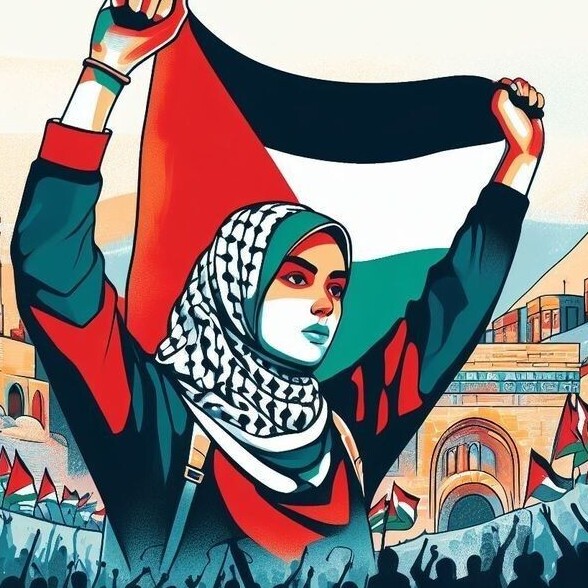
In the face of occupation and injustice, many South Asian women are standing at the forefront of global activism for Palestine. Their stories of courage, advocacy, and determination highlight the deep-rooted connections between their own histories of struggle and the ongoing Palestinian resistance. Here are some powerful stories of South Asian women who have bravely joined the fight for justice in Palestine.
1. Arundhati Roy – The Voice of Radical Solidarity
Renowned Indian author and activist Arundhati Roy has long been a vocal critic of imperialism, state violence, and human rights abuses, including those faced by Palestinians. Through her essays, public speeches, and interviews, Roy has passionately condemned the Israeli occupation and drawn parallels to India’s own struggles with Kashmir and its colonial past. Her courage lies in her unwavering commitment to speaking out, even when faced with severe backlash, and in using her literary platform to bring the plight of Palestinians to international attention.
Roy’s powerful writing on Palestine isn’t just political – it’s deeply personal. She understands the broader implications of imperialism and has stood in solidarity with Palestinians by comparing their suffering to the experiences of marginalized communities in South Asia. Her advocacy demonstrates how intellectuals can harness their influence to build global movements of solidarity.
2. Dr. Huma Dar – An Academic Champion for Palestinian Rights
Dr. Huma Dar, a prominent Pakistani-American academic, has been a significant voice in connecting the dots between the struggles of Palestinians and the marginalized communities within South Asia. As an associate professor at the University of California, Berkeley, her research focuses on colonialism, gender, and resistance, with a particular emphasis on Palestine and Kashmir.
What sets Dr. Dar apart is her courage to challenge both South Asian and Western communities to confront their complicity in the occupation of Palestine. Her speeches and academic work consistently highlight the intersectionality of oppressions, linking Islamophobia, casteism, and settler-colonialism. Dr. Dar has also actively organized educational events, protests, and boycotts, all aimed at supporting Palestinian self-determination.
3. Sana Saeed – The Digital Activist
Sana Saeed, a Pakistani-American journalist and producer, has used her platforms in journalism and social media to raise awareness about the occupation of Palestine and amplify Palestinian voices. Known for her work with Al Jazeera English and other media outlets, she has fearlessly covered stories that shed light on the Israeli occupation and the everyday struggles of Palestinians living under apartheid conditions.
Saeed’s courage comes from her ability to challenge mainstream media narratives that often frame the Israeli-Palestinian conflict in biased ways. She continually brings attention to the Palestinian cause on Twitter and other platforms, providing insightful commentary and factual reporting that educates her global audience. Saeed’s digital activism has become a beacon for many young South Asian women looking to speak out on global justice issues.
4. Ayesha Siddiqi – Amplifying Palestinian Voices in Creative Spaces
Ayesha Siddiqi, a Pakistani-American writer and cultural critic, has been an ardent supporter of Palestinian rights through her commentary on media, art, and culture. Using her sharp analytical voice, Siddiqi examines how Palestinian resistance is often marginalized in global discourse and how creative spaces can become platforms for advocacy.
Siddiqi’s courage is reflected in her criticism of institutions that uphold the status quo, including some within the entertainment industry. She has called for more inclusive representation of Palestinian stories, emphasizing that culture plays a crucial role in shaping public perception and activism. By amplifying Palestinian voices in art and media, she has played a significant role in expanding the reach of the solidarity movement.
5. Women on the Ground: South Asian Women Participating in Direct Action
Beyond the academics and journalists, there are countless South Asian women who have participated in protests, delegations, and direct action in Palestine. From India, Pakistan, Bangladesh, and the diaspora, these women have joined solidarity movements on the ground, working in refugee camps, participating in peaceful protests, and organizing against Israeli settler violence.
Many have shared stories of being arrested, threatened, or intimidated while participating in protests or boycotts. Yet, their courage never wavers. They often speak about how their own histories, such as the Indian struggle for independence, Pakistani women’s fight for human rights, and resistance movements in Bangladesh, inform their solidarity with Palestinians.
6. The Boycott, Divestment, and Sanctions (BDS) Movement
South Asian women have played a critical role in the BDS movement, which seeks to apply economic and political pressure on Israel to end its occupation of Palestinian territories. This global campaign has seen significant participation from South Asian academics, artists, and activists, who have called for boycotts of companies and institutions complicit in the occupation.
For example, South Asian feminist organizations have supported the cultural and academic boycotts by refusing to collaborate with Israeli institutions that normalize the occupation. These women have also organized boycotts of consumer products and tech companies that profit from the occupation, showing how economic tools can be leveraged to fight injustice.
7. Grassroots Activists Across South Asia
Within South Asia, grassroots movements in India, Pakistan, and Bangladesh have organized rallies, events, and fundraising campaigns in solidarity with Palestine. South Asian women have been at the forefront of many of these movements, mobilizing communities and drawing attention to the intersection of Palestinian oppression with issues like casteism, Islamophobia, and ethnic discrimination.
In Pakistan, for example, women’s organizations have held fundraisers for Palestinian refugees and worked to increase media coverage of the issue. Similarly, in India, despite political tensions, women’s groups have united to speak out against the human rights violations in Gaza, linking them to their own struggles against communal violence and state oppression.
Conclusion: A Legacy of Resistance
South Asian women fighting for justice in Palestine are continuing a legacy of global resistance. Their advocacy stems from a shared history of colonialism, systemic violence, and resistance to occupation. These courageous women – academics, activists, journalists, and community organizers – are showing that solidarity knows no borders. They are redefining the role of women in global justice movements, inspiring future generations to stand up for the oppressed and fight for a world where freedom and justice are universal rights.
No Responses